
Sometimes, when I’m having a bad day, I repeat a little mantra to myself: “at least I’m a nice person, and I smell good.” These two traits are so important to me that I’ve considered requesting that they be engraved on my tombstone.
As a teenager, the women I most looked up to, and most wanted to emulate in adulthood, had aesthetics that one would assume smell of sweat, stale cigarettes, and booze. They’re unkempt and messy, more focused on their art and their message than society’s expectation that women smell sweet, like baked goods or flowers. And I agree, but I can’t help but spend more time and money than my punk icons would respect, making sure I smell nothing short of pleasant.
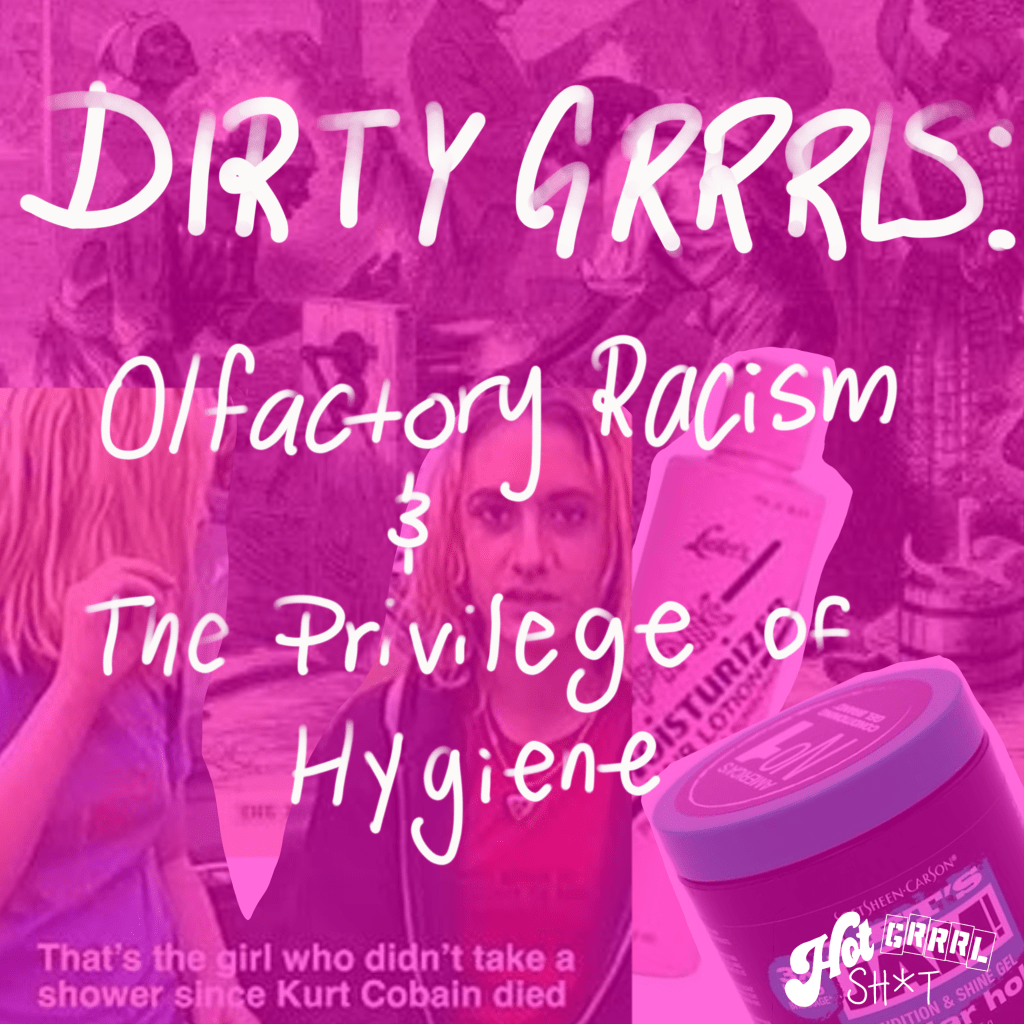
When a white woman smells bad, she’s subverting expectations for women; she’s sticking it to the man. Her sweat births subcultures and aesthetics. Documentaries are made about her bravery. When a Black woman smells bad, she’s ghetto and reinforcing the racial stereotype of poverty. But Black girls aren’t the only minorities to experience olfactory racism; almost all non-white women have experienced the association between their identity and negative smells. This perception of Black women, like most racist stereotypes, is rooted in Slavery.
In Andrew Kettler’s book The Smell of Slavery: Olfactory Racism and the Atlantic World, Kettler cites colonialist Daniel Fennings’ 1765 text about his experience in West Africa that describes African’s “wooly hair to be matted together with fat and dirt; their offensive smell, arising from their uncleanly customs; and their abominable lousiness” (pg 96). This sort of dehumanizing rhetoric was not only patently false but was also used to justify the inhumanities of slavery.
In turn, Black slaves were further dehumanized by being stripped of the right to bathe or change clothes while doing immense labor in hot conditions. Escaped Slave and Abolitionist John Andrew Jackson described how slaves were “ robbed of comfort and cleanliness by the cruelty and avarice of their masters,” (pg 125).
These days, white people, especially wealthy ones, use poor hygiene to create a sense of relatability. We saw it a year ago when dozens of white celebrities crawled out of the woodwork to let us know, against our will, that they only occasionally shower themselves and their children. We see it every month on social media, when white people discover that they’re the only ones who don’t use washcloths. We see it in influencers who brag about how little they shower or how bad they smell to gain our trust. We see it in subcultures that reinforce the idea that cleanliness is next to poser-ness.
One of my favorite examples of the glorification of dirtiness among white women is the 2000s documentary short, Dirty Girls. I love this film. I remember watching it in high school, and feeling so inspired by the bravery and aesthetics of the titular young women. But deep down, I knew that following in their footsteps wouldn’t get me the results I wanted. And it’s not just me.
So much of Black femininity is rooted in grooming. In various oils, butters, lotions, and sprays to maintain the natural beauty of our hair and skin. And while these things are all a part of the expectation to be presentable to polite society, there’s a lot of empowerment entangled in our upkeep. Oftentimes, we treat our hair and skin with the respect we don’t get from the outside world. By taking care of our hygiene, we are caring for ourselves in a way deeper than beauty conventions.
To better understand the deep relationship Black women have with scent, I spoke to Taylyn Washington-Harmon, creator of Black Girl Perfume Club. Washington-Harmon started Black Girl Perfume Club during the pandemic, when she, like the rest of us, fell into the online scent rabbit hole. But in her time experimenting with perfumes, she noticed something: “[Black Women] are simply not that represented in the fragrance space. Most major perfumers are white European men, and I think it’s interesting, because Black women are such high consumers of perfume and like beauty goods.”
A 2022 study from the NDP Group found that 85% of Black and Brown consumers regularly wear perfume and other scented products, compared to 78% of the total U.S. population.
Like most Black women, Washington-Harmon’s first memories of scent started at home, with the women in her family, “sitting on the porch and getting your hair done, and just like smelling all the different like oils and like the pink lotions and the stuff that you know we would put on our hair, like so much of it is also goes back to like hair care as well.”
For me, it’s the neon-teal, sickeningly sweet, candy-scented Let’s Jam hair gel, which I was always tempted to eat as a child. To this day, despite my desire to reach for more musky or edgy scents, I always land on something sweet in the gourmand family.
Washington-Harmon explains, “Black women, we love our gourmands. Yes, and I feel like it has to do.. I mean, it stems from our just our historical background, you know. Shea butters, cocoa butters, things that are native, you know, to the continent of Africa, particularly in West Africa. Like, those scents will consistently travel with us.”
On any given day, I smell like a mixture of Lush Supermilk, Viva La Juicy, Glossier You Fleur, and shea butter.
While Washington-Harmon encourages Black women to experiment with fragrance and fall in love with scent the way she did, she doesn’t want them to lose sight of themselves. “It hurts my soul that, like, we almost overconsume in the process…your scent is yours; you don’t have to go out smelling any kind of way. Be clean, own how you want to smell. Don’t feel like you have to smell a certain way just to appease others.”
Which brings me back to right where I started. Every morning, as I lather my skin and hair in various oils, lotions, and perfumes, am I participating in a ritual that reconnects me with my ancestors, reclaiming the hygienic rituals that were robbed from them, or am I participating in late-stage capitalism, hoping to appease white society through scent? Either way, I’m grateful to smell good.


Leave a Reply