
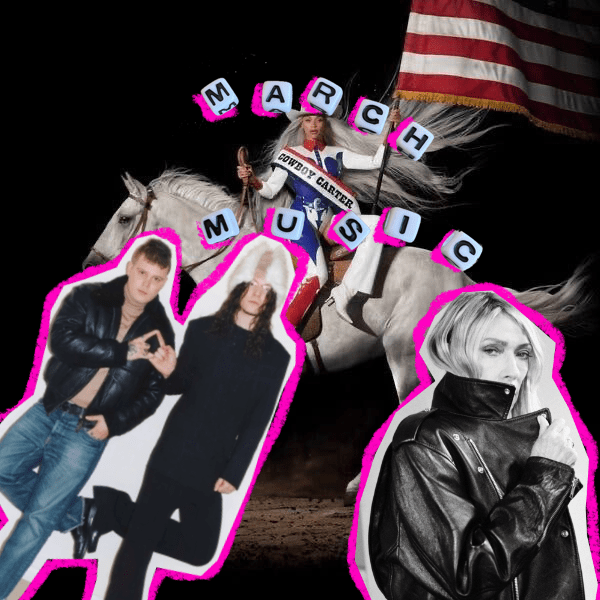
There’s no denying it, this past month was an incredible month for music. With releases from Adrienne Lanker, Beyonce, Ariana Grande, Mannequin Pussy, Fay Webster, Yung Lean and Bladee, Kim Gordon, Faye Webster, Kacey Musgraves, and Tierra Wack, March 2024 has been a musical heavy hitter. Among the March releases, there lays a common thread of genre-bending sounds. While some artists’ aesthetic pivots fell flat (*cough* Camilla Cabello *cough*), my three favorite releases of the month heavily focused on well-cemented artists exploring new territory.
For me, the albums that stood out the most from the past month were Cowboy Carter by Beyonce, Psykos by Yung Lean and Bladee, and The Collective by Kim Gordon. While it’s easy to look at all three of these albums as a reinvention for their respective artists, or a generic departure, the thing that drew me in the most about them is that, deep down, they’re just expansions of sounds that exist within each artist’s canon.
Cowboy Carter: Beyonce
With the release of the singles Texas Hold ‘em and Sixteen Carriages, music critics and audiences clung to the narrative that Beyonce was ‘going country’. A quick examination of Beyonces work proves that this narrative is not only reductive but rooted in racism. Country has not only been embedded in Beyonce’s music and aesthetic, from Destiny Childs early days performing in Huston rodeos, to the track Daddy Lessons on Lemonade, but also embedded in her identity as a black woman from Houston Texas. What makes Cowboy Carter so special is not that it’s an out-of-left-field or disingenuous shift for Beyonce. Instead, it’s a thoughtfully crafted commentary on the Black Southern experience in America, as well as a heartfelt tribute to Country as a genre and its origins.
The reveal of the Cowboy Carter album cover drew criticism from some fans, who viewed the image of a red-white-and-blue-clad Beyonce as an act of blind patriotism. I instead view the cover as an act of patriotism towards the America that Black people built. An ode to the indigenous culture of Black Americans. So many of the sounds, flavors, and aesthetics we associate with good old-fashioned America come from Black Southern tradition, including country music.
Cowboy Carter pays an ode to this tradition by highlighting the Black artists that have revolutionized the genre through it’s feature of artists like Linda Martell and Rhiannon Giddens, as well as its references to the Chitlin Circut. Beyonce further proves her country roots by featuring co-signs from bonafide Country legends like Dolly Parton and Willie Nelson in its interludes. A highlight of the Album is Beyonce’s touching cover of Blackbird, a song written by Paul McCartney for the black women of The Little Rock Nine. Beyonces choice to feature black female country artist on the cover not only made for a beautiful blend of voices on the track but also a touching acknowledgment of the role both music and Black women played during the civil rights era.
Psykos: Yung Lean and Bladee
Anyone who knows me could’ve easily predicted that I would love Psykos, partially because of the fact that I am wholeheartedly in love with Bladee. I will try to refrain from allowing my infatuation with the aforementioned (six-foot, curly-haired, blue-eyed, sensitive, and stylish) Swedish rapper to get in the way of my review.
I think what makes Bladee such a unique musical figure isn’t his technical skill as a rapper, but instead is his dissonant, dreamlike aesthetic, and emotional honesty. Both traits bode well in the alternative rock space.
Yung Lean and Bladee’s spacey, introspective lyricism, remains consistent on Psykos, despite the evolved sound.
Because of the highly emotional, loner aesthetic Bladee and Young Lean pioneered in the underground rap scene, it makes perfect sense that their most recent collaboration would fully lean into a pop-punk sound. This generic evolution makes sense for Yung Lean and Bladee and reflects how they’ve matured a both artists and people since the era of Soundcloud rap.
The Collective: Kim Gordon
I will admit upfront that, despite being a huge fan of hip-hop and underground/alternative rappers, I haven’t done much digging into Playboi Carti, or his Opium signee’s discographies. I attribute my hesitation to do so to my distaste for his predominantly white male fanbases’ reputation of dismissing female artists (look into why Rico Nasty stopped opening for Playboi Carti) and being godawful at moshing.
That being said, when it was announced that, at age 70 Kim Gordon’s new album had a ‘Playboi-Carti-vibe’, I was really interested in seeing her take on a modern sound so heavily inspired by the noise rock genre she pioneered.
One of the things that makes this album work so well is that the sound Kim Gordon established with Sonic Youth is already so intertwined with Hip-Hop. Throughout their career, Sonic Youth has collaborated with iconic Hip-Hop artists like Chuck D, Cypress Hill and Whodini. Sonic Youth’s sound has also informed so much of the noise/rock aspects of alternative and underground rap. Lil Peep, Tyler the Creator, and Clipping are just a few of the rappers that have sampled Sonic Youth Tracks.
The way Gordon layers her classic, dissonant vocals over booming trap beats makes The Collective feel less like a reinvention of her iconic rock aesthetic, but rather an extension of her boundary-pushing career.
Despite the album being heavily trap-inspired, Kim Gordon refrains from falling into the trap of infusing The Collective with stereotypically braggadocious rap bars. The subject matter is what makes The Collective feel so authentic to Kim Gordon. Songs like Bye Bye, which consists of Kim Gordon listing off her packing list, and I’m The Man, which is a commentary on the current state of toxic masculinity, are thematically in line with the rest of Gordon’s catalog.
 Hot Grrrl Shit
Leave a comment